

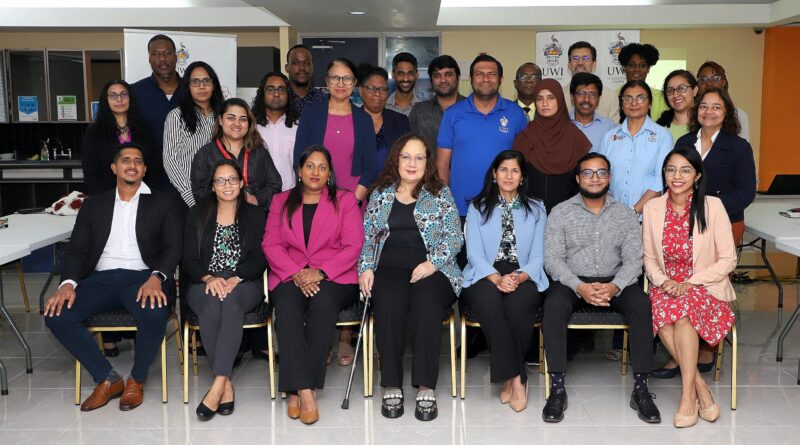
The University of the West Indies St. Augustine Campus has awarded approximately TT$9 million to 11 high-impact research projects through its RDI Fund.
The fund was established to support high-quality research and development that moves beyond knowledge generation to create demonstrable impact.
The 11 funded projects span climate resilience, renewable energy, agriculture and food security, artificial intelligence, robotics, waste management, public health, education and economic diversification.
The Fund’s Chairperson is Campus Principal, Professor Rose-Marie Belle Antoine, who says the investment as an important milestone for the successful researchers and the Campus’s broader research and innovation agenda.
She has since challenged them to consider from the outset, who will benefit from their research, how success will be demonstrated and how the benefits can extend beyond the life of the grant.
The University provided the following information regarding the research projects:
Among the funded projects is H2-TTransform, led by Dr. Graham King of the Department of Mechanical and Manufacturing Engineering, which is developing a testbed and proof-of-concept electrolyser for climate-resilient green hydrogen production in Trinidad and Tobago.
Agriculture and food security are also prominent areas of research. Dr. Romina Umaharan of The UWI’s Cocoa Research Centre is leading research to overcome the ‘Witches’ Broom Curse’ and build a climate-resilient cocoa industry, while Professor Arvind Singh is leading renewable-energy-driven agricultural engineering research.
Professor Rohanie Maharaj is researching bio-based edible coatings to reduce postharvest losses, while Dr. Wendy-Ann Isaac’s SCALe-UP project explores sustainable applications for the underutilised Giant African Snail in climate-resilient agriculture and enterprise development. Dr. Nigel Jalsa is developing environmentally friendly solutions for Giant African Snail control and controlled-release fertilisers.
The investment in emerging technologies includes AI4SIDS, led by Dr. Letetia Addison, which is developing an AI-driven climate resilience platform for Small Island Developing States, and research led by Dr. Craig Ramlal towards establishing a Caribbean autonomous systems and robotics industry.
Education, health and environmental sustainability are also represented. Dr. Phaedra S. Mohammed is leading LITERACY, which explores intelligent tutoring systems to enhance reading attainment among Caribbean youth. Dr. Shalini Pooransingh is examining non-communicable diseases and climate-sensitive food insecurity, while Dr. Akeem Mohammed is leading BioREFINE-XG, focused on developing a national waste-to-value chain roadmap for Trinidad and Tobago.