

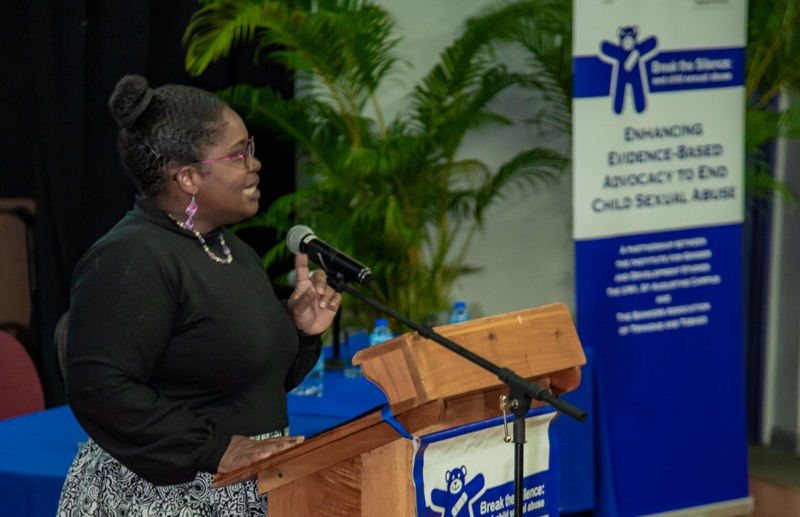
UWI St Augustine’s Institute for Gender and Development Studies is calling on authorities to prioritize Child Sexual Abuse as a central threat to human security and national development.
Since 2008, the Institute’s Break the Silence Action-Research project has sought to bring visibility to the issue.
Its most recent iteration of the BTS project is called “Filling the Gaps: Enhancing Evidence-Based Advocacy to End Child Sexual Abuse,” funded by the Bankers Association of Trinidad & Tobago.
It says young men and adult males in particular reinforced the significance of School Social Workers and School Guidance Officers in their decisions to report incidents of abuse.
The young men also cited the difficulty of speaking within the family and with peers, identifying the busyness of home and the fear of being ostracised if abuse is spoken about.
According to IDGS, reported cases of child sexual abuse have remained consistently high in T&T over the past decade.
The Children’s Authority estimates incidents of reported cases to be more than 10,800 between 2015 and 2023, averaging approximately 1,300 cases per year, or four children affected every day.
Recently, Childline launched its Technical Report of five years of research findings on this issue titled, “A Snapshot of Problems faced by Children in Trinidad and Tobago: Insights from Childline Data (2020-2025)”.
Among problems reported as part of the experience of 11,000 children studied, child sexual abuse affected 43.2% of the children (36.1% girls, 7.1% boys), signaling a steady continuation of its occurrence in T&T.
The Institute says BTS research findings, consistent with regional and international reports of CSA, indicate that in most instances the perpetrators are known to the child, often family members, close family friends, caregivers or individuals in positions of trust.
April is Child Abuse Prevention Month and Sexual Assault Awareness Month, and IGDS calls on the government to commit to the following:
• Ensure that our children have a wide cross section of safe spaces to which they can report incidents of abuse.
• Reinforce the importance of Guidance Officers and School Social Workers as necessary for ensuring these safe spaces for our children.
• Invest our education ecosystem to manage such reporting by ensuring such professionals form a sufficient and consistent part of the system.
• Ensure that such professionals form a consistent part of the education system.